
Black Friday arrives on November 27 this year, and some retailers have already started their sales. Millions of people will hunt for discounted laptops, phones, headphones, and gifts. Scammers know it, and they have been preparing for weeks.
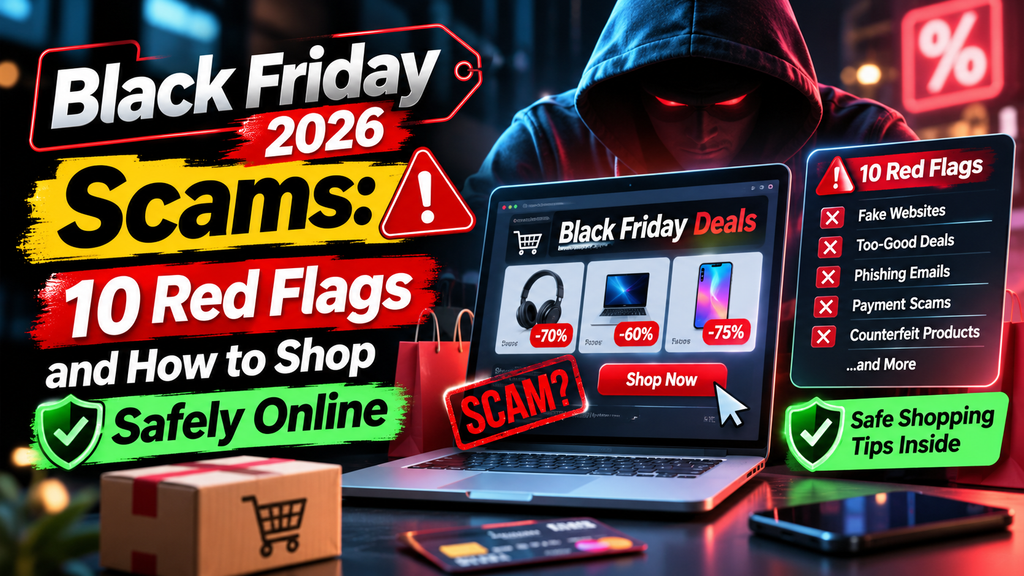
The tricks are not new: fake stores, bogus delivery texts, and deals that are too good to be true. What is new is the polish. Generative AI helps criminals write flawless emails and build convincing websites in minutes. Security editors have also flagged a fresh angle this season. In September, six major banks, including Bank of America and Capital One, warned that fraudsters could impersonate the AI shopping agents that now browse and buy on a customer’s behalf.
This guide covers the ten scams to watch for, the habits that protect you, and what to do if the worst happens. Spend ten minutes on it now and you can shop with confidence for the rest of the season.
1. Fake Online Stores
Criminals clone a popular retailer’s look or invent a store from scratch, then advertise ridiculous discounts. You pay, and nothing arrives, or a cheap knockoff shows up.
How to Spot Them
- The web address is slightly different from the real brand, such as an extra word, a swapped letter, or an unusual ending.
- The shop has no verifiable contact details, return policy, or business address.
- Reviews are generic, repeated, or all posted around the same time.
- Payment options are limited to bank transfer, crypto, or gift cards.
Safer habit: Type the retailer’s address yourself or use a bookmark. Do not trust a link from an ad, email, or text.
2. Too-Good-to-Be-True Deals
A brand-new console at 90 percent off is not a bargain. It is bait. Scammers rely on the excitement of Black Friday to make you skip your usual caution.
Not every bad deal is a scam, though. One analysis cited by Aura found that 36 percent of Black Friday sale items in 2025 offered no savings compared with prices a few weeks earlier. Stores also advertise doorbuster deals in tiny quantities to draw shoppers in.
Safer habit: Compare the price at two or three other retailers, and check price history with a tracking tool before you buy.
3. Fake Delivery Notifications
During a shopping rush, almost everyone is waiting for a package. A text saying “Your delivery failed, click to reschedule” feels believable. The link leads to a phishing site that steals card details or asks for a small “redelivery fee.”
Safer habit: Never tap links in unexpected texts. Check the tracking number in your order confirmation email, or sign in to the store or carrier’s official app or website.
4. Fake Order Confirmations and Billing Errors
You receive a message saying your order for an expensive item is confirmed, or that there was a payment problem. Panic sets in, and you click to “cancel” or “fix” it. The page then asks for your login or card details.
Red flags include: purchases you never made, requests to verify payment information, and pressure to act fast.
Safer habit: Open the retailer’s app or site yourself and check your order history. If the order is not there, delete the message.
5. Fake Sale Ads on Social Media
Social feeds are full of “limited-time” ads for famous brands. Some link to stores that never ship, or add huge shipping fees after you apply a discount code.
Safer habit: If an ad catches your eye, skip the link. Go to the retailer’s own website and see whether the deal exists there.
6. Gift Card Scams
Gift cards are easy to buy, hard to trace, and almost impossible to refund. Fake stores, scam calls, and fraudulent messages often demand payment in Amazon, Apple, or other gift cards.
Rule of thumb: No legitimate retailer, bank, or government agency will ask you to pay with gift cards. If someone does, it is a scam.
7. Account Verification and Refund Scams
Messages claiming “suspicious activity on your account” or promising a refund or survey reward aim to create urgency. The link leads to a fake login page that harvests your password.
Safer habit: Do not log in through a message link. Go to the official site or app, and turn on two-factor authentication for your shopping and email accounts.
8. Fake Travel Deals
Cheap flights and hotel packages are popular Black Friday targets. Scammers take full payment upfront and then vanish, or add surprise fees.
Red flags include: prices far below market, no verifiable agency address, and demands for full payment by bank transfer.
Safer habit: Book through well-known airlines, hotels, or established travel sites, and pay by card for stronger protection.
9. Impersonation of AI Shopping Agents
This is the newest risk. More shoppers now let AI agents search, compare, and buy for them. Banks have warned that criminals may impersonate these agents or the services behind them to trick people or redirect payments.
How to Protect Yourself
- Use agents only from companies you know and trust, and sign in through their official apps.
- Set spending limits and require your approval before any purchase.
- Review every order confirmation, especially the merchant name and total.
- Be suspicious of unsolicited messages claiming your “shopping assistant” needs new permissions or payment details.
10. Public Wi-Fi Snooping
Mall and cafe networks can be risky. Researchers warn that attackers can intercept data on poorly secured public Wi-Fi.
Safer habit: Avoid entering card details on public Wi-Fi. Use your mobile data instead, or a trusted VPN if you must use shared networks.
Your Black Friday Safety Checklist
Use this list before every purchase:
- Set a budget and a shopping list so impulse buys do not slip through.
- Type the store’s address or use a bookmark.
- Look for “https” and a real contact page, but remember that scam sites can have both.
- Search the store’s name plus “scam” or “reviews” on an independent site.
- Pay with a credit card, a virtual card number, or a trusted payment service. These often offer stronger dispute rights than debit cards or bank transfers, though protections vary by country and provider.
- Turn on transaction alerts from your bank or card app.
- Use a password manager and unique passwords for each shopping account.
- Enable two-factor authentication, ideally with an authenticator app or passkey.
- Keep your phone and apps updated so security patches are installed.
- Save your receipts and screenshots of the product page and order confirmation.
What to Do If You Get Scammed
Act quickly, because speed improves your chances of recovering money.
- Contact your bank or card issuer and report the transaction. Ask about freezing the card and starting a dispute.
- Change passwords on any account where you entered credentials, starting with email, and sign out of all devices.
- Scan your device with a reputable security tool if you downloaded anything.
- Watch your accounts for unusual activity over the following weeks.
- Report the scam to your country’s consumer protection or cybercrime agency, and to the platform where you saw the ad.
- Warn family and friends, since scammers often reuse the same story.
Frequently Asked Questions
When is Black Friday 2026?
Black Friday falls on Friday, November 27, 2026, the day after US Thanksgiving. Cyber Monday follows on November 30. Many retailers start their deals earlier in the month.
How can I tell if a shopping website is real?
Check the exact web address, look for a physical address and working contact details, read independent reviews, and be wary of unusual payment methods. When in doubt, buy from a retailer you already know.
Is it safe to click links in sale emails?
It is safer to avoid them. Instead, visit the retailer’s website directly or use its official app. Legitimate deals will appear there too.
Are credit cards safer than debit cards for online shopping?
Often, yes. Credit cards and virtual cards usually provide stronger dispute protections and do not expose your bank balance directly. The exact rules depend on your country and card issuer, so check your provider’s policy.
Can AI shopping agents be trusted?
They can be convenient, but treat them like any financial tool. Use well-known providers, limit permissions and spending, and review every purchase. Banks have already warned about impersonation, so stay alert.
Conclusion
Black Friday scams succeed because they exploit speed, excitement, and trust. You can beat them with a few simple habits: go to stores directly, ignore unexpected links, compare prices, pay with protected methods, and turn on two-factor authentication. If a deal feels too good to be true, take a breath and verify it. A real bargain will still be there after you check, and a scam will not.