
Choosing what to study after graduation is not always about picking the more prestigious qualification. It is about understanding what you actually want from the next stage of your career.
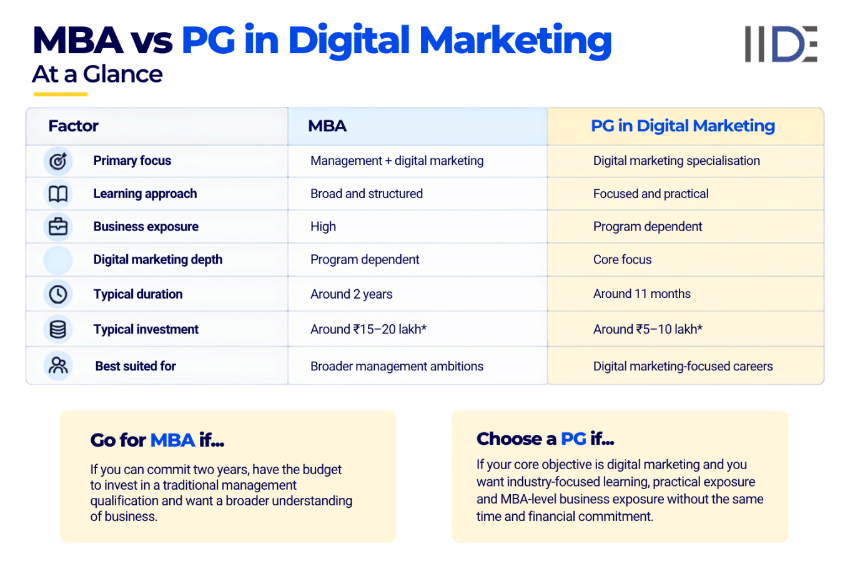
If you can commit two years, have the budget to invest in a traditional management qualification and want a broader understanding of business, an MBA in Digital Marketing can be the right choice.
But if your core objective is digital marketing and you want industry-focused learning, practical exposure and MBA-level business exposure without the same time and financial commitment, a specialised PG can be a better route.
IIDE’s PG Program in Digital Marketing is one option that comes close to an MBA in Digital Marketing while taking around 11 months and requiring a much lower investment. Its focus on practical learning and placement outcomes also makes it worth considering for students who want to build a strong foundation in digital marketing.
MBA vs PG in Digital Marketing at a Glance
The simplest way to look at the difference is breadth versus specialisation.
| Factor | MBA | PG in Digital Marketing |
| Primary focus | Management + digital marketing | Digital marketing specialisation |
| Learning approach | Broad and structured | Focused and practical |
| Business exposure | High | Program dependent |
| Digital marketing depth | Program dependent | Core focus |
| Typical duration | Around 2 years | Around 11 months |
| Typical investment | Around ₹15–20 lakh* | Around ₹5–10 lakh* |
| Best suited for | Broader management ambitions | Digital marketing-focused careers |
*Fees vary significantly by institution and program, so students should verify the current fee before making a decision.
An MBA spends more time building management and business understanding alongside marketing. A specialised PG spends more of that learning time on digital marketing itself.
A PG can be the better choice for students who already know that digital marketing is the career they want. It offers a more focused learning path and can help students enter the industry sooner. The shorter duration and lower investment can also make it a more practical option.
Curriculum: What Will You Actually Learn?
Digital marketing today covers much more than social media. Roles can involve SEO, performance marketing, content, analytics, e-commerce, AI tools and growth.
An MBA generally combines these areas with a wider management curriculum.
| Curriculum Area | MBA | PG in Digital Marketing |
| Marketing | Core subject | Core subject |
| SEO | Program dependent | Core skill |
| Performance marketing | Program dependent | Core skill |
| Social media | Included | Core skill |
| Analytics | Included | Core skill |
| AI tools | Program dependent | Integrated learning |
| Business strategy | Broader exposure | Program dependent |
For example, IIDE’s PG in Digital Marketing currently covers 750 learning hours across nine modules, with areas including performance marketing, SEO, content, social media and analytics.
What’s interesting is that its PG in Digital Marketing & Business Strategy track goes further with 1,000 learning hours across 15 modules, adding areas such as AI strategy, P&L management, sales, entrepreneurship, e-commerce and growth strategy.
This gives students an important choice: specialise deeply in digital marketing or combine digital marketing with a stronger understanding of how businesses operate and grow.
Cost and Duration: What Is the Real Investment?
Course fees are only one part of the equation. Students should also consider how long they will be studying before they can enter the workforce.
| Factor | MBA | PG in Digital Marketing |
| Duration | Generally 2 years | Around 11 months |
| Typical investment | ₹15–20 lakh | ₹5–10 lakh |
| Learning approach | Broad and structured | Focused and intensive |
| Industry entry | Later | Potentially earlier |
| Main investment | Management education | Specialised skills |
The difference becomes significant when time is considered alongside money. A two-year MBA can offer broader exposure, but it also means a longer academic commitment and a higher overall investment in many institutions.
A specialised PG can compress digital marketing education into a shorter period.
Practical Learning, Skills and Career Preparation
The qualification on your CV may help you get noticed, but what you can actually demonstrate can matter just as much when applying for digital marketing roles.
| Learning Factor | MBA | PG in Digital Marketing |
| Case studies | Common | Included |
| Live projects | Focused | Strong focus |
| Industry exposure | Institution dependent | Integrated |
| Tool-based learning | Program dependent | Strong focus |
| Portfolio building | Program dependent | Emphasised |
| Campaign experience | Program dependent | Stronger focus |
An MBA can provide strong classroom learning, case studies and business exposure. A specialised PG can put more emphasis on live projects, tools, campaigns and industry interaction.
Career and Placement Opportunities
The career direction is another important difference.
An MBA in Digital Marketing can keep the door open to broader marketing, brand management and business roles. A specialised PG is more closely aligned with digital marketing functions from the beginning.
| Career Factor | MBA | PG in Digital Marketing |
| Marketing roles | Strong | Strong |
| Digital marketing | Strong | Core focus |
| SEO | Possible | Strong alignment |
| Performance marketing | Possible | Strong alignment |
| Social media | Possible | Strong alignment |
| Strategy | Strong pathway | Business-focused PG options |
| Portfolio development | Program dependent | Live projects |
| Placement support | Institution dependent | Program dependent |
| Average salary | Varies by institution | Varies by institute |
For students who want to keep their options broad, the MBA route has an obvious advantage.
But for someone targeting digital marketing roles specifically, a focused program can reduce the gap between what they study and what employers expect of them.
This is also where program quality matters. IIDE currently reports a 93% placement rate with a highest CTC of ₹19 LPA on its placement page. Its hiring ecosystem includes brands such as Google, Unilever, McDonald’s, Nykaa, GroupM, Dentsu, Colgate, Godrej, ICICI Bank, Flipkart, Accenture and FCB Kinnect.
These are institute-reported figures and should be evaluated alongside the program’s eligibility and placement conditions.
So there you have it! We hope this comparison gives you the clarity you need to choose the path that best aligns with your career goals.

Leave a Reply